Cognitive Weaning: On Negative Capability, Witnessed Trust, and the Pipes in the Forest
It was the interlock that piqued my interest. Not the stone pillars anchoring the massive wrought iron gates. Not any of the brand spanking new Ontario Parks signs, though I did look at the map. The interlock looked like my uncle's walkway in Whitby. The same colour, even. Meaning it dated back to the 80s and it was expensive. It was everywhere; overgrown and mossy but mostly in good shape. Weird thing to find in a new park but maybe that's why they were calling it Uxbridge's Urban Park. My dog didn't care and we set off to explore. As we walked, things got weirder. I decided there were Manderley vibes.
Nature had come into her own again and, little by little, in her stealthy, insidious way had encroached upon the drive with long, tenacious fingers. The woods, always a menace even in the past, had triumphed in the end. — Daphne du Maurier, Rebecca
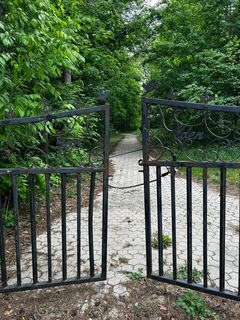
I had seen the park advertised on Instagram and decided it was worth the drive to check out a new walking area. I'm fortunate to have so much choice but when you walk a dog 4-6 times a day, 365 days a year, it's nice to have different places to investigate. I often choose the forest when neighbourhood small talk is getting on my nerves. I integrate meditation practices into my walks and spend a lot of time noticing. There are fewer interruptions in the forest. This was a rich day for noticing. Halfway through, streetlights appeared. Dark standards with modern industrial curves but rising from the earth looking like they had never lit anyone's way. It would have been more fitting if they had been gothic. We found clearings, a new picnic table, bat boxes, but also dark, dense sections of forest that made me feel like there really could be a mansion burned down, hidden in the shadows. At the end of the second path, there was another set of gates and two men getting out of their truck with their dogs. Always a question whether you engage in the middle of nowhere, but my dog is very large and very protective. He didn't raise any alarm, so I let my curiosity lead. They commented that they didn't understand why the parking lots were full so I told them about Instagram and the new urban park designation.
"You really couldn't find nowhere better?"
Then they told me the whole thing. A rich man. A planned housing development that never got final approval. Infrastructure installed for a future that didn't arrive — the interlock, the lights, the gates, pipes sticking out the forest, connecting nothing. Staff who used to power-wash the paths weekly. Eventually a land swap with the province. And yes, there had been a house. It burned down. They laughed about that too. "You can feel it, huh?"
Infrastructure for a future that never showed up, being quietly rewilded by a landscape that never needed it.
Local legend, a sanitized history remembered only by the people who lived it, who remembered the disputes, the discussions about required infrastructure. There would be records in archives if I really wanted to investigate but I like the story as it is. It has the taste of truth, of lived experience told to me, a stranger, by a long-time resident with deep roots and a long memory. The details don't really matter. It's the difference between the truth and curation. Where does the story start? According to the locals? 1980s. Ontario Parks? 2024. If you consider what I've said before about witnessed trust, you know where I'm laying my bet on what's true.
So how do you know what's truth?
A podcast guest of mine, Meagan Williamson, posted a picture of her kids playing on an old-fashioned metal slide. The caption said something like "I gave them the 80s childhood experience." I DM'd her: they must have loved that :) She said "yes, once they stopped asking me for things." I responded, "Cognitive weaning."
As a parent, I know to value boredom. I was an only child and yes, Gen X. I did drink out of the hose; I was a latch key kid (found it not too long ago on the same ribbon I used to wear around my neck). And I played on slides like the one in Meagan's picture. You can't find many anymore. They often date back to the 50s or 60s and they are tall, rickety; an insurance nightmare. The last time I saw one was at the old drive in on the edge of Queensville. My kids loved it too.
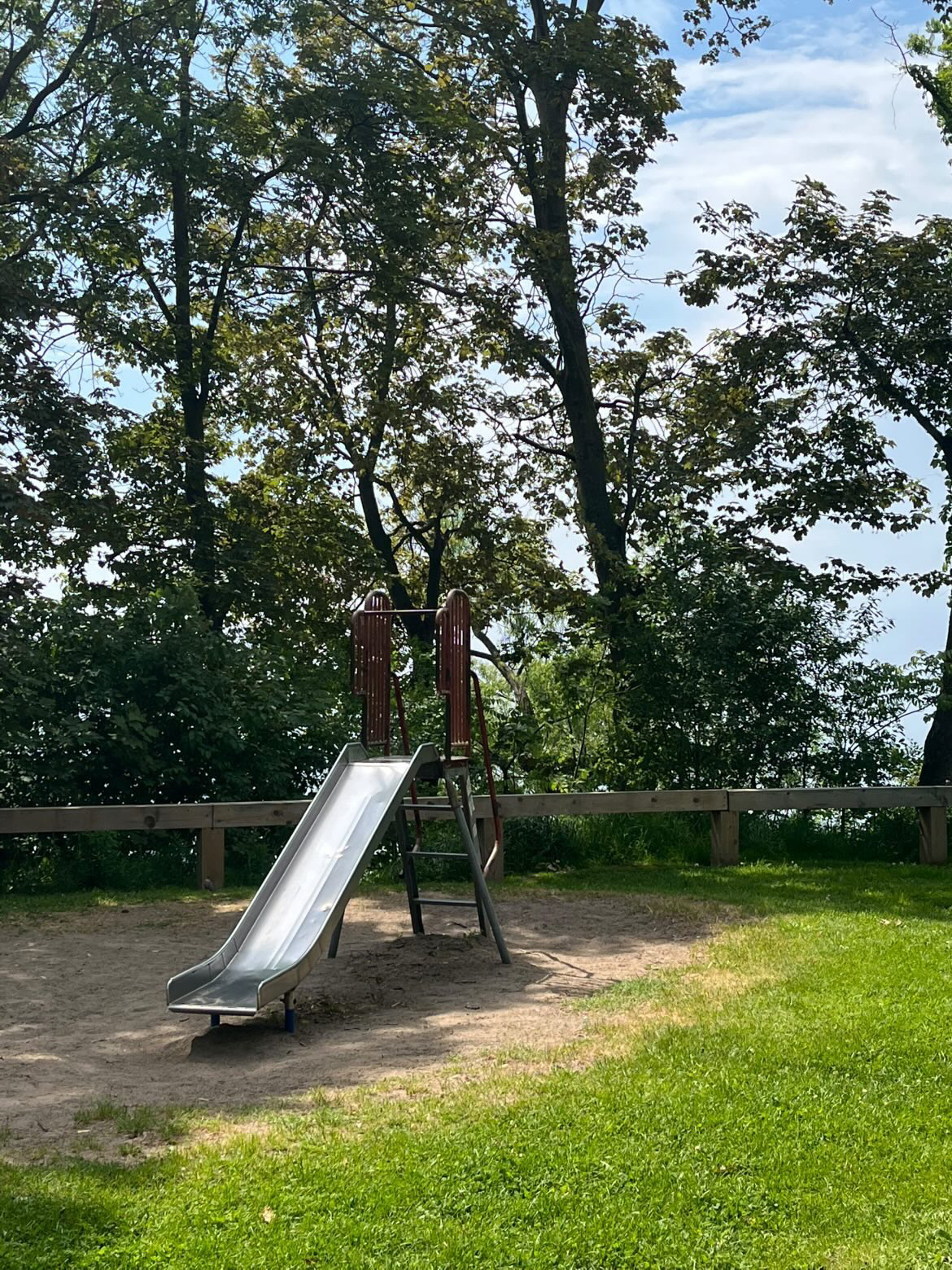
Photo: Meagan Williamson
When I looked at her picture, I could hear the kids in the playground. I could feel the burn of the metal against my legs, see the glint of the sun, the woosh of air in my hair. It felt like truth. It's a memory for Meagan and myself but present moment for her kids. What's different is that Meagan had to step back and create the space, the freedom from supervision and mediation that Gen X had baked into our childhood.
Have I mentioned Meagan has a background in psychology? She used to work for the school board doing psych assessments and designing Individual Education plans before she had to redesign her whole world because her kids had high care needs as babies and she couldn't work the way she used to before they were born. My daughters both have IEPs and I'm very familiar with that role. I don't have a psychology background, but I've had to educate myself to advocate for my kids.
Meagan thought cognitive weaning was the perfect phrase. She went one further and shared it on Threads and Instagram and credited me. Called it genius.
Meagan has a background in psychology, runs a marketing business built for the long game, and she's a parent. When something resonates that hard with her, I pay attention.
I know cognitive weaning in my own body too. I breastfed both my daughters. The first I weaned at ten months — I had two months left on my leave and the timeline was external, the decision practical. Hard, but clean. The second was different. I'd been back at work since eleven months. By the time I weaned her at fifteen months, the feeds had narrowed to the threshold hours — early morning when she woke, late evening before sleep. And I knew, sitting in that early morning quiet, that the ritual had become something I was no longer sure was entirely for her. I knew I wasn't having any more babies.
Breastfeeding is an identity. A responsibility. A role. A performance. Embodied competence — something that was agony at first, that you learned, that became effortless, that your body eventually just knew. When it ends, you are retiring a skill at the top of it.
And the protest is real. The reaching, the asking, the expectation that someone will answer. You have to hold your ground through all of it. Which requires its own kind of trust — that the discomfort is not damage, that they will find the slide eventually.
Weaning is always bilateral. Meagan stepping back from her kids. Me weaning my daughter. The two men in the forest letting the property tell its own story instead of correcting Ontario Parks' version. Somebody has to hold the space and somebody has to walk into it.
How do we create space so we can take advantage of the benefits of boredom?
By embracing another concept I've been noticing. Negative capability. It traces back to John Keats.
Negative capability is Keats's term for the ability to remain present inside uncertainty, ambiguity, and the unknown without rushing to resolve it. It is the disciplined capacity to withstand not knowing — and to stay open, receptive, and imaginative rather than collapsing into premature certainty. Yes, this comes from Wikipedia. It's clean, it's clear, and best of all, you have permission to find that Henry Cavill gif and use it well. You know the one.
I don't have a love of poetry. I couldn't quote a Keats poem. But I've noticed other people writing about this concept recently. Rachel Botsman, an expert on trust, has been writing about it directly. She points out that Keats used "negative" not in the pejorative sense, but to connote the ability to not do something. The capacity to not jump, not answer, not engage defensively, not shoehorn.
The interesting thing about Meagan is that she's really observant about the current state of marketing and she's very generous with sharing what she notices. It's because of her that I first heard about a furniture flipper who had a $1.2 million launch teaching people to yap on camera. At first glance, furniture flipping and yapping on camera don't seem to be a match made in heaven. But it's what happens when your skill at getting people to pay attention to the thing you do exceeds your skill at the thing you do.
What caught my attention is that Meagan was ignoring it.
Watching the launch industry collectively lose its mind teaching everyone how to be "louder online" while the smartest business owners I know are quietly building search assets and disappearing for the summer. The contrast is wild.
She is naming negative capability. The ability not to do something.
My response was: it's a different understanding of control and trust.
We don't have to do all the things. We don't have to absorb all the things. More content isn't going to be the magic. There's too much. The number one complaint I saw about the woman with the successful launch was that everyone had jumped online and started yapping. I have no idea if any of this works because I mostly avoid talking head videos unless you are teaching me to contour makeup I'll never wear. Just kidding. Sometimes I watch people I know.
Because there is so much uncertainty about algorithms, AI, the change to search, SEO, AEO, GEO (do I even know what that one is?), people who earn an income online are leaning into fear when they do all the things. More things means more control. Spray and pray. It's a defensive manoeuvre, not future-focused strategy.
And the yapping isn't just defensive. It's the producer offloading the discomfort of their own uncertainty by transferring the cognitive load to the reader. The flood asks the consumer to do the sorting and the filtering, to decide what mattered. The producer gets to feel productive. The reader gets to feel buried.
We all need to experience cognitive weaning to know what we really think and feel.
It's the same pattern I get consulted on — in the moment before a major commitment, before the technology gets adopted, the function restructured, the contract signed. The moment most people skip.
The problem in those rooms is never intelligence. It's the distance that has grown between what people know and their willingness to act on it. The vendor's assurances. The consultant's framework. The benchmark data. The fact that everyone else is doing it. The urgency that arrived from somewhere upstream and was never examined.
The extended data-gathering often has less to do with decision quality than with distributing responsibility for it. More input means more people implicated. It buys a longer runway before anyone has to commit. And when the thing goes sideways, you can point to the process.
The work isn't to give them the answer. It's to hold the ground while they find the slide.
The view that arrives before all the input is usually the view the room ends up with. The information gathering changes the language. It rarely changes the direction.
I delete Threads, Instagram, and TikTok on a rotation. Not in a rage, not as a statement. Just when I notice the space where my own thinking used to form has filled with other people's framings and I can't tell anymore which observations are mine.
The feeds aren't bad. The DM about the metal slide started on Instagram. Two phrases arrived fully formed because the context was right. But there's a colonizing quality I've learned to feel before I can fully name it. And the only move that works is deletion. Not a pause. Not a notification mute. The app, gone, until the signal clears. The parasocial pull is what makes deletion the only move that works. You can't mute someone you feel you know.
This is cognitive weaning as ongoing practice, not one-time transition. Sometimes you come back.
So the convergence I'm testing this summer is cognitive weaning, negative capability, and witnessed trust. Less reaching. Less filling. Less performing the work in real time so the algorithm can see it. More forest. More friction. More boredom. More noticing what my own body and pattern-reader already know before I let whatever shows up next in the feed decide for me.
The two men in the forest knew the story because they had lived nearby long enough for it to settle into them. The kids on the metal slide knew what to do because their mother trusted them to figure it out. I weaned my babies because independent feeding is a step towards normal development.
The discomfort is the mechanism. Not the malfunction.
How much input do you need to know what you think?